
Description
Tesamorelin Research Peptide
What Is Tesamorelin?
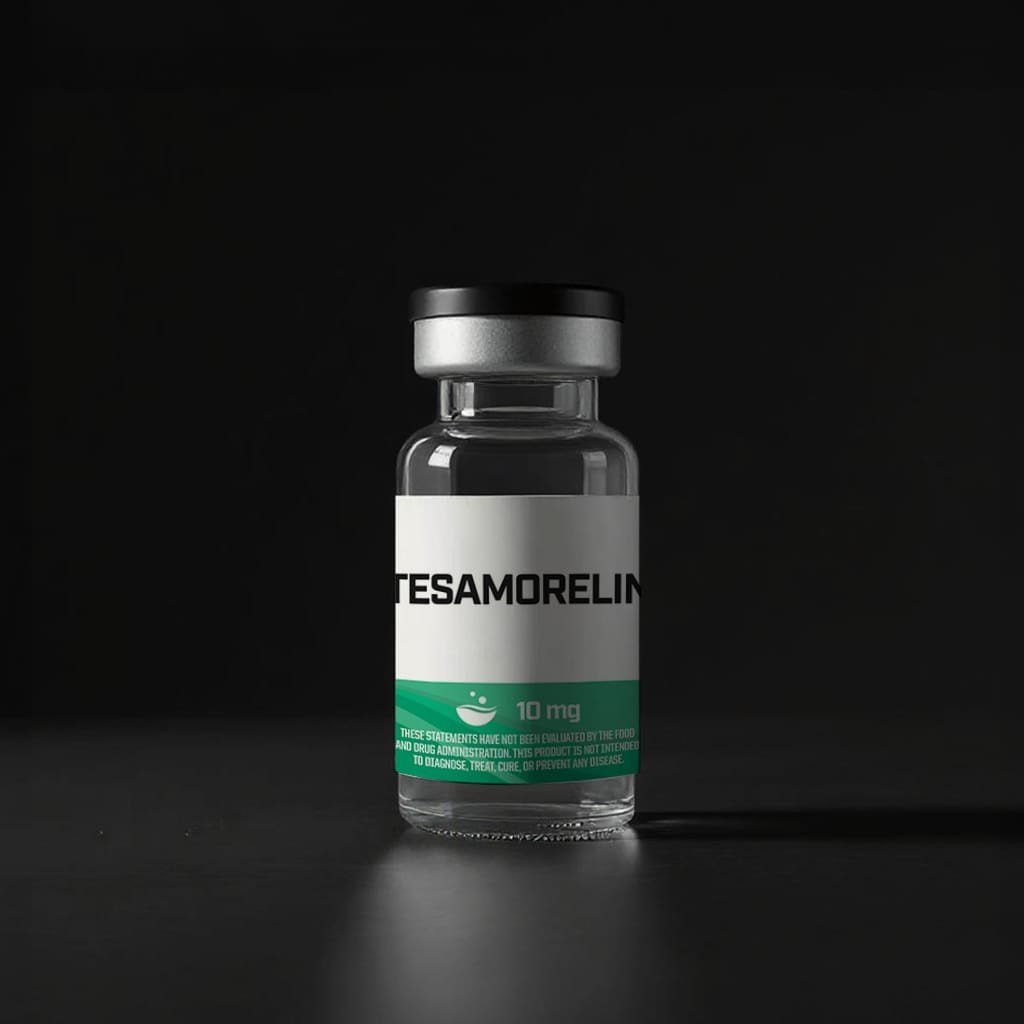
Tesamorelin Research Peptide is a synthetic growth hormone-releasing hormone analogue, also described as a growth hormone-releasing factor analogue. It contains the complete 44-amino-acid sequence of human GHRH with a six-carbon hexenoyl group attached to its N-terminal tyrosine. This modification increases resistance to enzymatic degradation while preserving activity at the human GHRH receptor. Tesamorelin has also been identified by the development code TH9507 and is the active peptide used in regulated EGRIFTA formulations.
Tesamorelin can be examined through Soma Chems Lab alongside other compounds in the broader research peptide collection.
GHRH Receptor and Growth Hormone Signalling
Tesamorelin binds the growth hormone-releasing hormone receptor, or GHRHR, on somatotroph cells within the anterior pituitary. GHRHR is a G-protein-coupled receptor that normally responds to hypothalamic GHRH and regulates the synthesis and pulsatile release of endogenous growth hormone.
Receptor activation primarily stimulates the Gs–adenylyl cyclase pathway, increasing intracellular cyclic AMP and activating protein kinase A. This signalling supports growth-hormone gene transcription and hormone release from pituitary cells. Tesamorelin stimulates the receptor with potency similar to endogenous GHRH rather than acting as externally supplied growth hormone.
Released growth hormone binds receptors on adipocytes, hepatocytes, myocytes and other responsive cells. In adipose tissue, GH promotes the mobilisation of stored triglycerides through lipolytic pathways. In the liver and peripheral tissues, GH also increases production of insulin-like growth factor 1 and its carrier protein IGFBP-3. IGF-1 mediates several growth-related and metabolic effects of the GH axis, although not every GH response depends on IGF-1.
Evidence From Laboratory and Human Research
Cell-based receptor experiments confirm that tesamorelin stimulates human GHRH receptors. Animal pharmacology supported its ability to increase endogenous GH secretion before human clinical development, but metabolic outcomes observed in animals cannot independently predict effects in people.
Tesamorelin has a substantially larger human evidence base than most research peptides. Randomised, placebo-controlled trials in adults with HIV-associated abdominal fat accumulation reported reductions in visceral adipose tissue while generally preserving subcutaneous abdominal fat. One combined analysis reported an approximate 18% reduction among participants continuing tesamorelin, while extension studies showed that the effect was not maintained after treatment withdrawal.
Research has also examined liver fat, muscle composition and metabolic biomarkers. These findings remain population-specific: evidence obtained from adults with HIV-associated lipodystrophy should not be generalised to ordinary obesity, athletic performance, ageing or unrelated endocrine conditions. Current prescribing information explicitly states that regulated tesamorelin is not indicated for general weight-loss management, and its long-term cardiovascular effects have not been established.
Comparison With Related Peptides
The TB500, Thymosin Alpha-1 and BPC157 research blend combines peptides associated with cytoskeletal, immune and endothelial research. It has no established shared receptor and lacks combination-specific clinical trials. Tesamorelin instead acts through a defined pituitary GHRH receptor and has controlled human evidence supporting activation of the GH–IGF-1 axis.
Prostamax Research Peptide is associated with short peptide-bioregulator research involving prostate-derived tissues and proposed gene-expression effects. It is not a GHRH analogue and does not share tesamorelin’s pituitary receptor target, endocrine signalling pathway or clinical evidence base.
Current Evidence and Limitations
Tesamorelin’s mechanism and clinical pharmacology are comparatively well characterised, but important uncertainties remain. Evidence is concentrated in a specific HIV-associated population, prolonged IGF-1 elevation has incompletely defined consequences, and human metabolism studies remain limited. Results from approved tesamorelin formulations also cannot establish the composition, pharmacokinetics or biological equivalence of unrelated research materials.
Frequently Asked Questions
Is tesamorelin the same as growth hormone?
No. Tesamorelin stimulates pituitary GHRH receptors to increase endogenous GH release; it is not recombinant growth hormone.
Is tesamorelin the same as sermorelin?
No. Tesamorelin contains the full modified 44-residue GHRH sequence, whereas sermorelin corresponds to the shorter GHRH 1–29 fragment.
Does tesamorelin increase IGF-1?
Human studies and prescribing data show that stimulation of endogenous GH is followed by increased IGF-1 and IGFBP-3 levels.
Additional information
Tesamorelin Research Peptide
$49.99
Synthetic GHRH analogue researched for growth hormone and IGF-1 signalling.
Reviews
Clear filtersThere are no reviews yet.