

Description
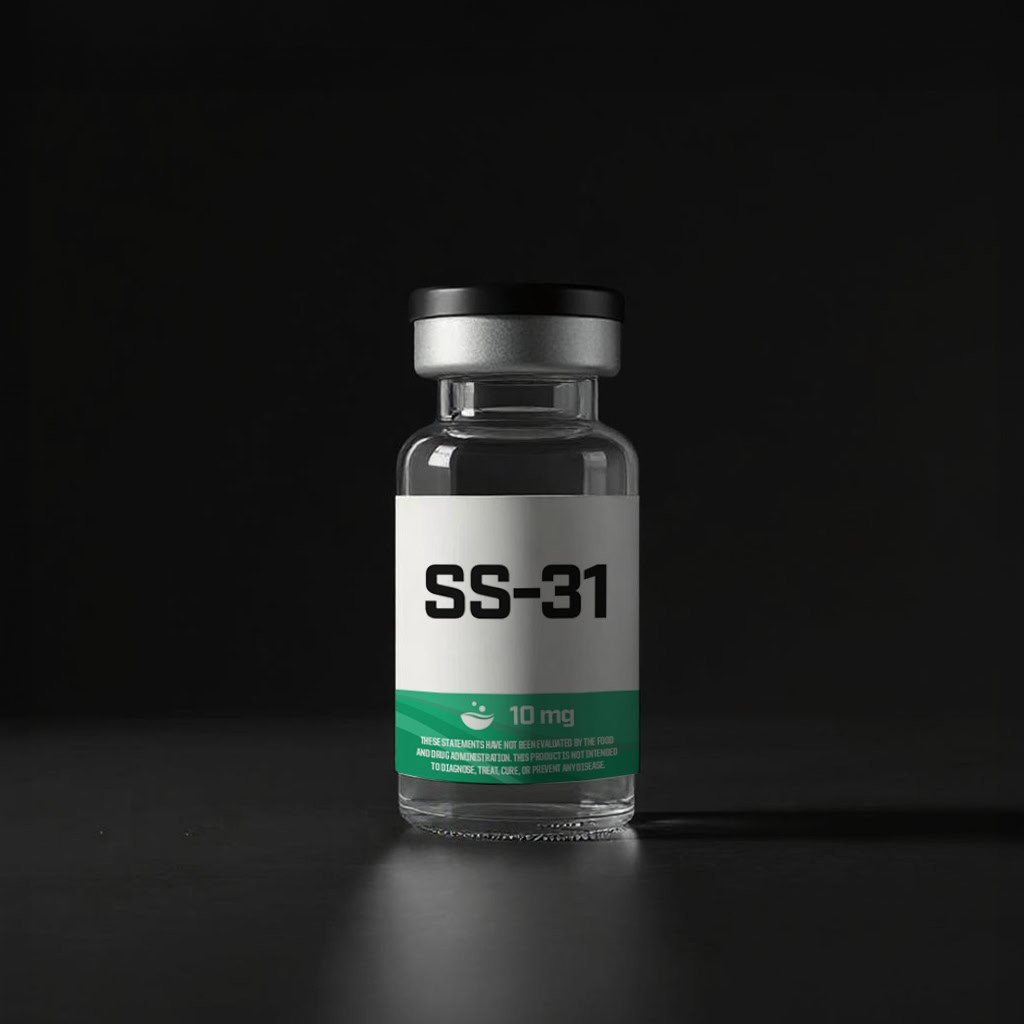
SS-31 Research Peptide
What Is SS-31?
SS-31 Research Peptide is a synthetic, mitochondria-targeting tetrapeptide with the sequence D-Arg–2′,6′-dimethyltyrosine–Lys–Phe-NH₂. It is also known as elamipretide, MTP-131 and Bendavia and belongs to the aromatic-cationic Szeto–Schiller peptide class. Its primary research context is mitochondrial membrane organization, oxidative phosphorylation and cellular energy production. SS-31 appears within the Soma Chems Lab research peptide collection.
Cardiolipin and Mitochondrial Mechanism
SS-31 does not depend on a conventional cell-surface receptor. Its best-supported molecular interaction is reversible binding to cardiolipin, a negatively charged phospholipid concentrated within the inner mitochondrial membrane. Cardiolipin helps maintain cristae architecture and organizes respiratory-chain proteins that transfer electrons and establish the proton gradient used by ATP synthase.
Cytochrome c normally transfers electrons between respiratory complexes III and IV. When its interaction with cardiolipin becomes disrupted, cytochrome c can adopt peroxidase-like activity that promotes cardiolipin oxidation and mitochondrial stress. Experimental research indicates that SS-31 modulates the cardiolipin–cytochrome c interaction, limits peroxidase activity and preserves cytochrome c’s electron-carrier function.
By stabilizing the inner membrane environment, SS-31 has been associated in preclinical models with improved electron transport, reduced electron leakage, lower reactive-oxygen-species generation and more efficient ATP production. These effects represent bioenergetic modulation; the peptide does not directly manufacture ATP or function merely as a conventional antioxidant scavenger.
Cellular, Animal and Human Evidence
Cellular and animal studies have examined SS-31 in models involving ischemia–reperfusion injury, skeletal-muscle dysfunction, kidney stress, cardiac injury and inherited mitochondrial disorders. Mitochondrial respiration, cristae structure, oxidative damage and ATP production are common experimental endpoints, although responses differ across tissues and disease mechanisms.
Human evidence is more developed than for many experimental peptides. A randomized study in older adults reported increased skeletal-muscle mitochondrial ATP-production capacity following elamipretide exposure. However, the phase III MMPOWER-3 trial in primary mitochondrial myopathy found no significant improvement in six-minute walking distance or fatigue after 24 weeks compared with placebo.
On September 19, 2025, the FDA granted accelerated approval to elamipretide hydrochloride for improving muscle strength in patients with Barth syndrome weighing at least 30 kilograms. The decision was based on an intermediate knee-extensor-strength endpoint, and continued approval requires confirmation of clinical benefit. This approval applies to the regulated pharmaceutical formulation and does not establish equivalence for unrelated research materials.
Comparison With Related Peptides
Sermorelin Research Peptide is a GHRH(1–29) analogue that activates pituitary GHRH receptors through Gs, cyclic-AMP and protein-kinase-A signalling. Sermorelin therefore influences endogenous growth-hormone release, whereas SS-31 acts primarily through cardiolipin-associated mitochondrial membrane biology.
FOXO4-DRI/Proxofim Research Peptide is an all-D retro-inverso peptide designed to disrupt the FOXO4–p53 interaction in senescent cells. Its proposed senolytic mechanism promotes p53-dependent apoptosis and is distinct from SS-31’s effects on respiratory-chain efficiency and mitochondrial structure.
Current Evidence and Limitations
SS-31 has a defined structure, an experimentally supported cardiolipin interaction and extensive clinical development, but results are not uniformly positive across mitochondrial disorders. Findings from Barth syndrome, primary mitochondrial myopathy or older-adult studies should not be generalized to healthy ageing, athletic performance or unrelated conditions.
Frequently Asked Questions
Is SS-31 the same as elamipretide?
Yes. SS-31 is the original research designation for the tetrapeptide developed clinically as elamipretide.
Does SS-31 directly scavenge reactive oxygen species?
Its principal proposed action is improving cardiolipin-dependent mitochondrial organization and electron transport, which can reduce ROS formation indirectly.
Does SS-31 have human clinical evidence?
Yes, including randomized trials and an accelerated FDA approval for a narrowly defined Barth syndrome indication, although controlled outcomes have differed across conditions.
Additional information
SS-31
$54.99
Mitochondria-targeting peptide researched for cardiolipin and cellular energy pathways.
Reviews
Clear filtersThere are no reviews yet.