
Description
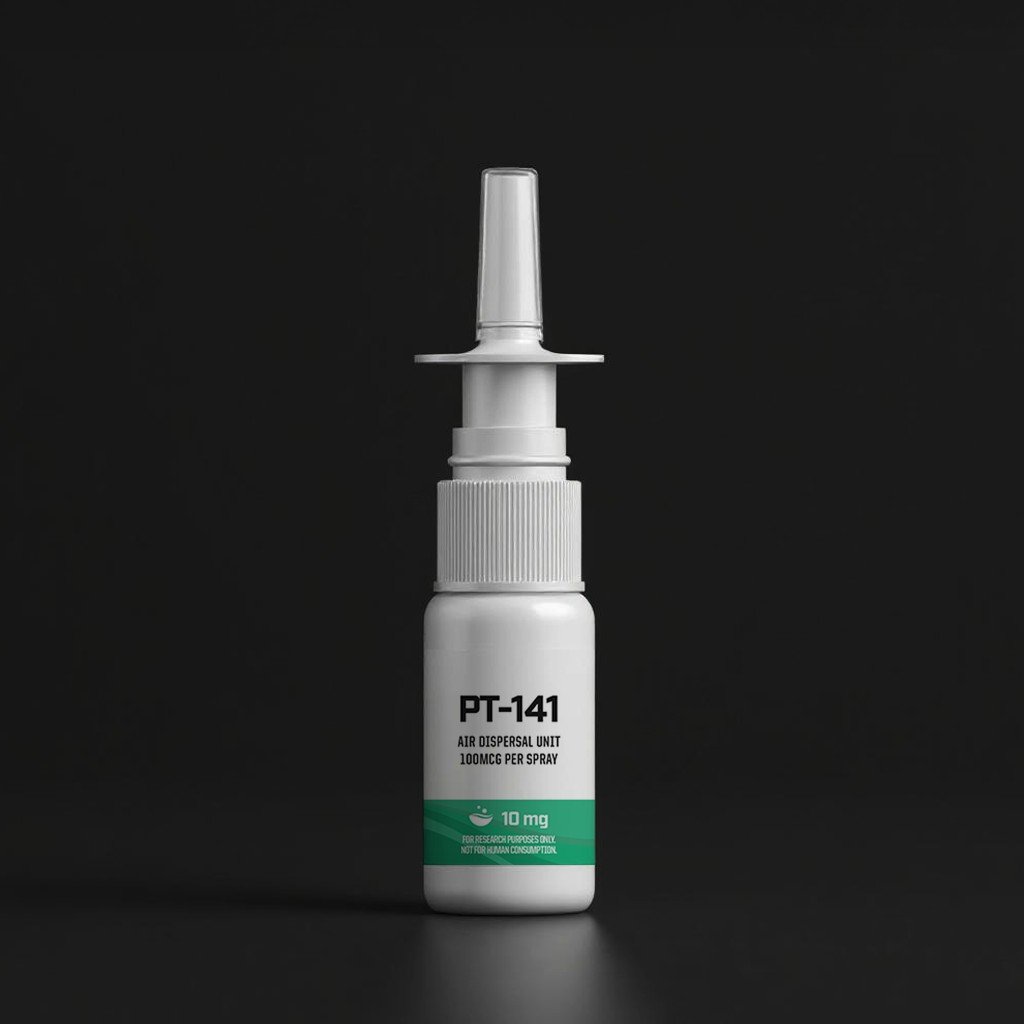
PT-141 Spray Research Peptide
What Is PT-141?
PT-141, also known as bremelanotide, is a synthetic cyclic heptapeptide and nonselective melanocortin receptor agonist investigated in neuroendocrine, motivational and sexual-behaviour research. Its structure, Ac-Nle-cyclo-(Asp-His-D-Phe-Arg-Trp-Lys-OH), contains the melanocortin pharmacophore derived from α-melanocyte-stimulating hormone analogue research and was developed through work on melanotan-II-related peptides.
Researchers exploring PT-141 Spray Research Peptide can examine it alongside other laboratory compounds from Soma Chems Lab and the wider peptide spray research collection.
Melanocortin Receptor Activity
Cell-based receptor studies identify PT-141 as an agonist at all five melanocortin receptor subtypes, with the reported potency order MC1R, MC4R, MC3R, MC5R and MC2R. These receptors are G-protein-coupled receptors normally activated by peptide hormones produced from the POMC gene, including α-MSH and adrenocorticotropic hormone. Their activation commonly stimulates adenylyl cyclase and raises cyclic AMP, creating intracellular signals that vary according to receptor subtype and tissue.
MC4R is widely expressed in the central nervous system and participates in motivational, autonomic and energy-regulation circuits. Animal research proposes that PT-141 activates MC4R-associated neurons in the medial preoptic area of the hypothalamus, potentially increasing local dopamine release. Dopamine within this region contributes to incentive motivation and the organisation of sexual behaviour, although this proposed sequence has not been conclusively demonstrated in humans.
MC1R is concentrated on melanocytes. Its activation stimulates the cAMP–PKA–CREB pathway, increasing the activity of the transcription factor MITF and melanogenic enzymes such as tyrosinase. PT-141’s MC1R activity therefore represents a peripheral pigmentation-related pathway distinct from its hypothesised central MC4R effects.
Evidence Across Research Models
In cellular systems, receptor-binding and functional assays establish melanocortin agonism but cannot reproduce complex behavioural responses. In rats and nonhuman primates, PT-141 produced behavioural and physiological changes associated with sexual response, while rat studies detected increased hypothalamic c-Fos, a marker of neuronal activation.
Early human research evaluated intranasal PT-141 in healthy men, participants with erectile dysfunction and small groups of premenopausal women. Later Phase III trials studied subcutaneous bremelanotide in premenopausal women with acquired, generalised hypoactive sexual desire disorder and reported statistically significant changes in desire and associated distress compared with placebo.
Comparison With Related Compounds
PT-141 differs fundamentally from NAD Spray Research Peptide. NAD is a nucleotide-derived coenzyme that transfers electrons during metabolic redox reactions and serves as a substrate for enzymes including sirtuins and poly-ADP-ribose polymerases; it is not a melanocortin ligand.
Noopept Spray Research Peptide, also called omberacetam, is a peptide-derived small molecule investigated primarily in cognitive and neurotrophic models. Rodent findings involving hippocampal NGF and BDNF expression describe a different research pathway from PT-141’s melanocortin receptor activity.
Current Limitations
The exact human pathway connecting melanocortin receptor activation with measured clinical outcomes remains unresolved. Clinical findings are concentrated in narrowly defined populations, and independent re-analysis has questioned effect size, outcome reporting and clinical interpretation. Route-dependent exposure also means evidence from regulated injectable or earlier intranasal formulations cannot establish the pharmacokinetics or biological performance of an independently formulated research spray.
Frequently Asked Questions
Is PT-141 the same as bremelanotide?
Yes. PT-141 is the former development designation for the cyclic peptide assigned the generic name bremelanotide.
Is PT-141 selective for MC4R?
No. MC4R is central to several neurological hypotheses, but PT-141 also activates MC1R, MC3R, MC5R and MC2R.
Is a PT-141 spray equivalent to injectable bremelanotide?
No equivalence can be assumed without formulation-specific analytical, pharmacokinetic and biological data because delivery route can substantially alter systemic exposure.
Additional information
Pt-141 Research Peptide
$49.99
PT-141 Spray Research Peptide (bremelanotide) is a synthetic cyclic peptide investigated for its activity at melanocortin receptors in neuroendocrine and receptor signalling research. For laboratory research use only.
Reviews
Clear filtersThere are no reviews yet.