
Description
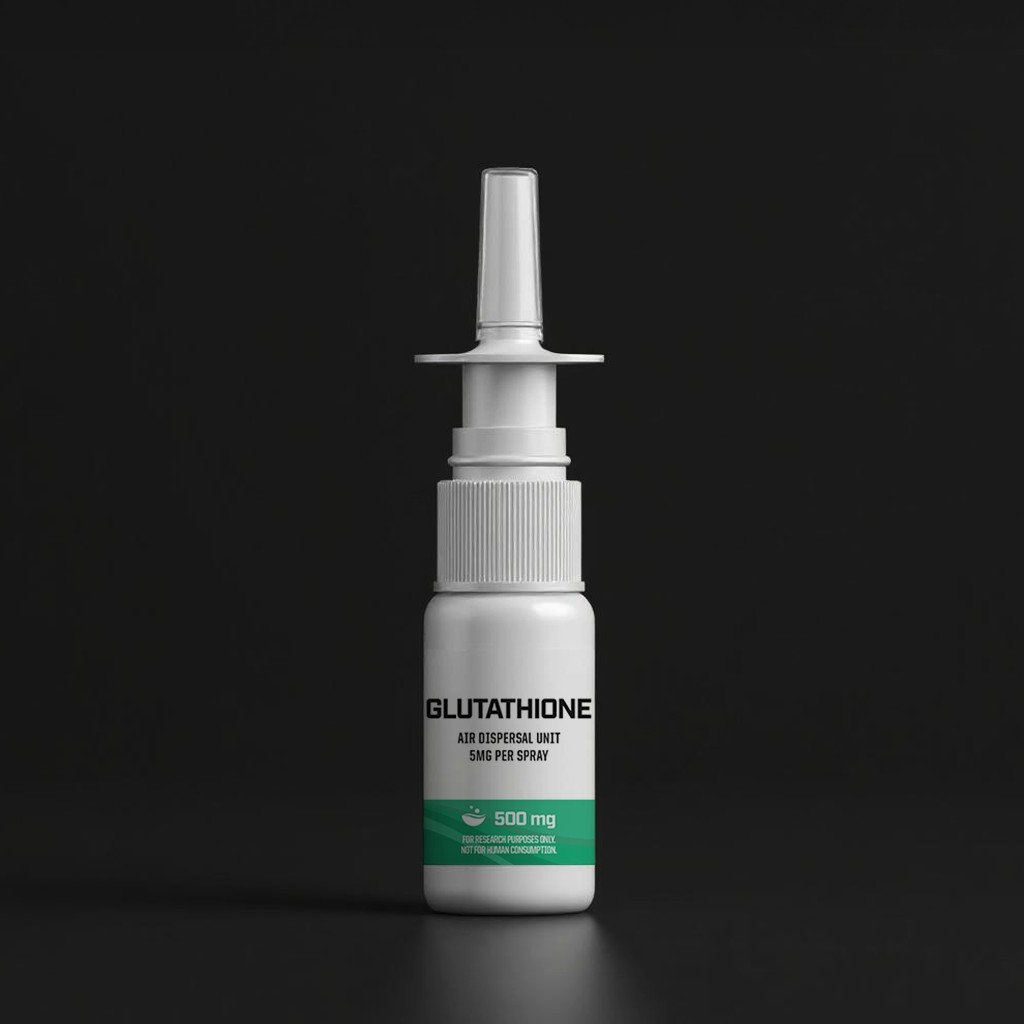
Glutathione Spray Research Peptide
What Is Glutathione?
Glutathione Spray Research Peptide refers to glutathione, an endogenous sulfur-containing tripeptide composed of glutamate, cysteine and glycine. Its reduced form is abbreviated GSH and is also called γ-L-glutamyl-L-cysteinylglycine; oxidation links two molecules through their cysteine sulfur atoms to form glutathione disulfide, or GSSG. Glutathione is not primarily a receptor-binding peptide. It functions as a low-molecular-weight thiol, enzyme co-substrate and redox regulator studied in oxidative-stress biology, cellular metabolism and xenobiotic processing. The product name alone does not establish whether a spray contains GSH, GSSG or another glutathione derivative.
Researchers examining endogenous redox compounds can explore glutathione through Soma Chems Lab alongside the broader peptide spray research collection.
Biosynthesis and Redox Mechanism
Cells synthesize GSH in the cytosol through two ATP-dependent reactions. Glutamate-cysteine ligase first joins glutamate to cysteine; its catalytic GCLC subunit performs the reaction, while GCLM modifies enzyme efficiency and sensitivity to feedback inhibition. Glutathione synthetase, encoded by GSS, then adds glycine. Cysteine availability and glutamate-cysteine ligase activity commonly limit the rate of synthesis.
Glutathione peroxidases use GSH to reduce hydrogen peroxide and lipid hydroperoxides, oxidizing GSH to GSSG in the process. Glutathione reductase, encoded by GSR, uses NADPH to regenerate GSH and preserve the intracellular GSH:GSSG redox balance. Glutathione S-transferases use GSH to conjugate reactive electrophiles, supporting their subsequent transport and metabolism.
GSH also participates in protein S-glutathionylation, a reversible modification in which glutathione forms a mixed disulfide with a protein cysteine. This can protect sensitive thiols from irreversible oxidation while changing protein activity, interactions or cellular location. Glutaredoxin enzymes reverse the modification, allowing S-glutathionylation to operate as a redox-sensitive regulatory switch.
Evidence and Research Limitations
Cellular evidence for glutathione synthesis, peroxide reduction, electrophile conjugation and protein-thiol regulation is extensive. Animal studies show that modifying GSH synthesis or recycling changes oxidative-stress responses, but findings vary by tissue, species and experimental model.
Human spray evidence is narrower. A magnetic-resonance spectroscopy study involving 15 participants reported increased brain GSH after intranasal reduced glutathione. A Phase I/IIa study examined tolerability in 30 participants, while a subsequent placebo-controlled Phase IIb trial enrolled 45 participants; all groups improved, and neither glutathione group was superior to placebo on the primary symptomatic comparison. Patent claims involving intranasal glutathione establish proposed formulations or uses, not verified biological equivalence or clinical efficacy.
Comparison With Related Spray Compounds
MT-II Spray Research Peptide is a synthetic cyclic melanocortin agonist that activates melanocortin receptors, making its receptor-driven pharmacology fundamentally different from glutathione’s enzyme-linked redox chemistry.
Semax Spray Research Peptide is a synthetic ACTH-fragment analogue investigated mainly in neurological and neurotrophic models. Animal studies connect Semax with changes in BDNF-related signalling, whereas glutathione research centres on thiol balance, peroxide metabolism and protein redox regulation.
Frequently Asked Questions
Is glutathione a conventional receptor agonist?
No. Its major established roles involve chemical reduction, enzyme-dependent peroxide processing, electrophile conjugation and reversible modification of protein cysteines.
Are GSH and GSSG identical?
No. GSH is the reduced thiol form, while GSSG is the disulfide produced when two glutathione molecules become oxidized.
Does research on intranasal GSH prove that every glutathione spray has the same activity?
No. Redox form, formulation, concentration, delivery characteristics and analytical identity can alter exposure, so results from one studied preparation cannot be transferred automatically to another.
Additional information
GLUTATHIONE SPRAY Research Peptide
$139.98
Glutathione Spray Research Peptide is an endogenous tripeptide investigated for its role in cellular redox balance, antioxidant defense and glutathione-dependent enzyme pathways.
Reviews
Clear filtersThere are no reviews yet.