
Description
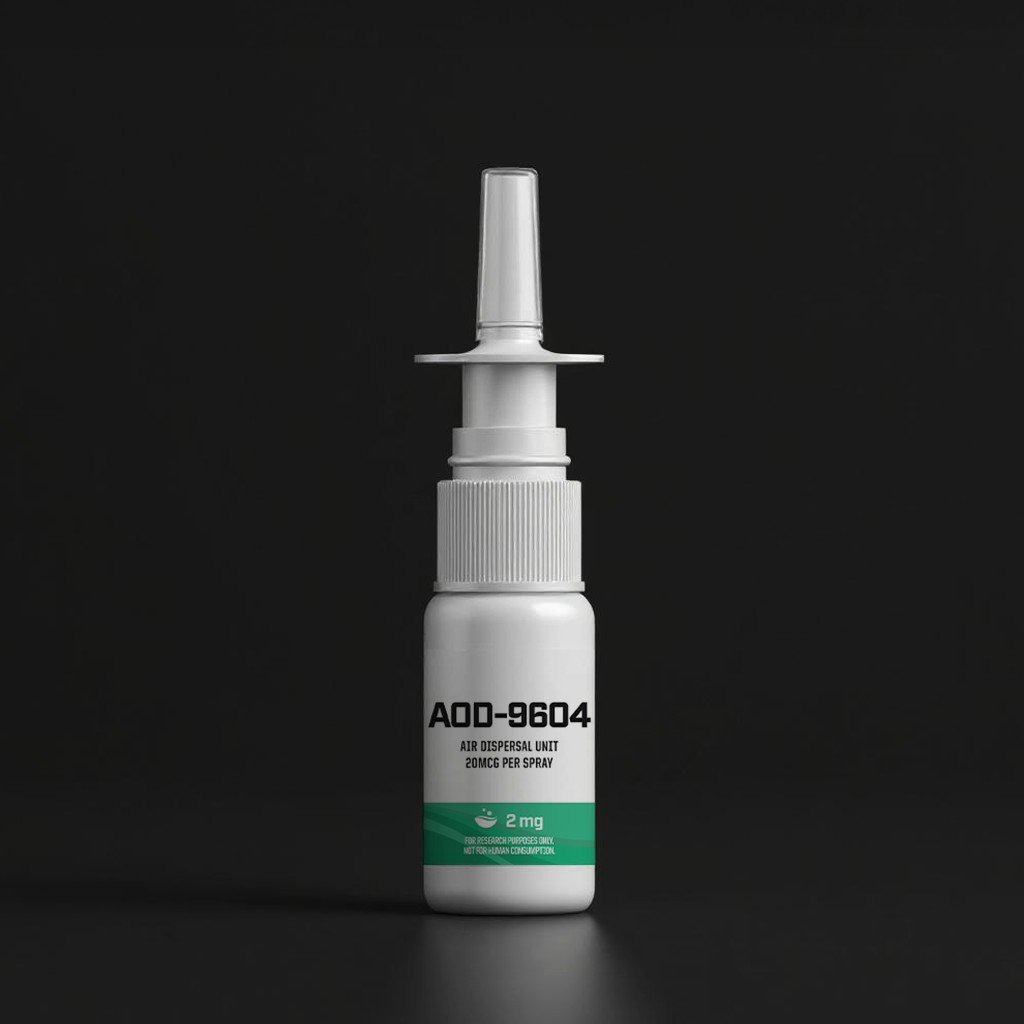
AOD-9604 Spray Research Peptide
What Is AOD-9604?
AOD-9604 Spray Research Peptide refers to AOD-9604, later developed as LAT8881, a synthetic disulfide-constrained hexadecapeptide derived from the carboxyl terminus of human growth hormone. It contains hGH residues 177–191 plus an added N-terminal tyrosine, producing the sequence YLRIVQCRSVEGSCGF with a disulfide bridge between its two cysteines. Unlike full-length 191-amino-acid hGH, AOD-9604 was developed for research into lipid metabolism without reproducing classical growth-promoting hormone signalling.
Researchers can examine this compound through Soma Chems Lab and the broader peptide spray research collection.
Growth-Hormone and Metabolic Pathways
Full-length hGH activates the growth hormone receptor by engaging two receptor-binding sites, promoting receptor dimerisation and downstream JAK2–STAT5 signalling that contributes to hepatic IGF-1 production. AOD-9604 lacks the complete two-site architecture required for this process. Competition-binding and cell-proliferation assays found no meaningful hGH-receptor activation, while human studies reported no elevation of circulating IGF-1. These findings distinguish AOD-9604 from intact hGH but do not establish one definitive metabolic receptor.
In obese rodent models, AOD-9604 increased lipolytic activity, fat oxidation and β3-adrenergic-receptor expression while reducing weight gain. β3-adrenergic receptors normally couple to Gs proteins, adenylyl cyclase, cyclic AMP and protein kinase A, creating signals that regulate triglyceride mobilisation in adipose tissue. Knockout experiments showed that long-term weight and lipolysis effects were lost when β3 receptors were absent, although acute fat oxidation still occurred and investigators concluded that AOD-9604 did not act directly through the receptor.
Emerging Targets and Research Models
Newer work using the LAT8881 name identified LANCL1 as a peptide-binding target in nervous-system models through photo-affinity pull-down and siRNA knockdown. LANCL1 is an intracellular membrane-associated protein linked to glutathione interactions, cellular stress responses and neuronal excitability. In rodent neuropathic models, LAT8881 reduced abnormal sensory-neuron activity and mechanical hypersensitivity; this is preclinical evidence for a pathway distinct from the earlier adipose research.
Cellular cartilage studies and a small rabbit osteoarthritis model also examined matrix production and tissue structure. Rabbit joints receiving locally delivered AOD-9604 showed lower cartilage-damage scores than saline controls, but the small groups, local joint exposure and species-specific model do not establish comparable spray activity.
Human Evidence and Limitations
Six clinical studies involving 936 participants evaluated intravenous or oral AOD-9604 during its obesity-development programme. The final Phase II efficacy study did not meet its primary weight-loss endpoint, and development for obesity was discontinued. Later neuropathic-pain studies also used oral or intravenous LAT8881. These programmes do not establish the absorption, pharmacokinetics or biological activity of an AOD-9604 spray formulation.
Comparison With Related Sprays
Dream Catcher Spray Research Peptide is presented as a blend-style rest and circadian research formulation without one publicly verified standardized active molecule, preventing receptor-level comparison with chemically defined AOD-9604.
TB-500 Spray Research Peptide is associated with Ac-LKKTETQ, a thymosin-β4-derived fragment studied through actin binding, cytoskeletal organisation and cell migration. Those pathways differ from AOD-9604’s growth-hormone-fragment origin, β3-adrenergic metabolic research and emerging LANCL1 interaction.
Frequently Asked Questions
Is AOD-9604 the same as full-length human growth hormone?
No. It is a 16-amino-acid synthetic fragment based on hGH residues 177–191 with an additional N-terminal tyrosine.
Does AOD-9604 activate the growth hormone receptor?
Available binding and proliferation studies indicate that it does not meaningfully activate the classical hGH receptor–IGF-1 pathway.
Do oral, intravenous or animal studies prove that AOD-9604 spray behaves similarly?
No. Spray stability, mucosal transport, absorption and systemic exposure require formulation-specific evidence.
Additional information
AOD-9604 9604mg Research Peptide
$69.99
AOD-9604 Spray Research Peptide is a synthetic growth hormone fragment investigated for metabolic signalling, lipid metabolism and related cellular pathways.
Reviews
Clear filtersThere are no reviews yet.