
Description
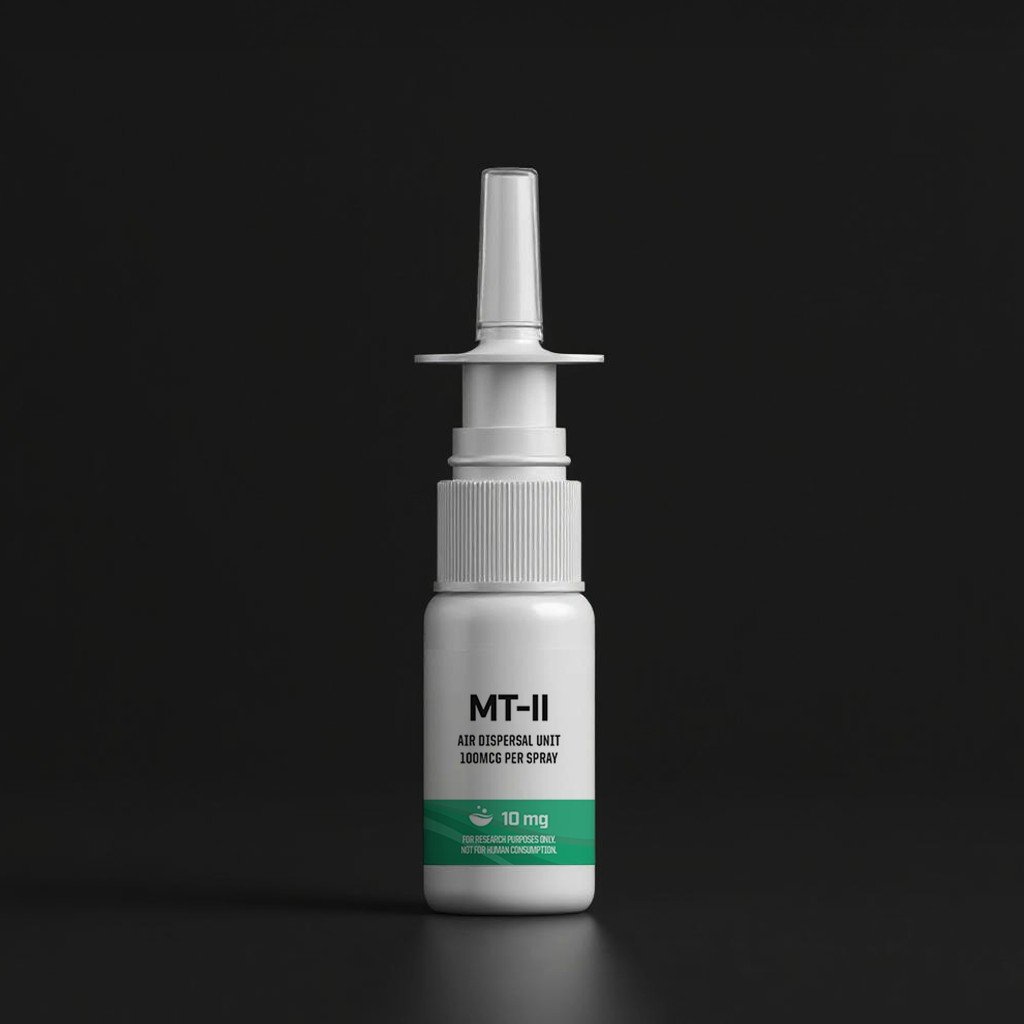
MT-II Spray Research Peptide
What Is MT-II?
MT-II Spray Research Peptide refers to Melanotan II, a synthetic lactam-cyclized heptapeptide analogue of alpha-melanocyte-stimulating hormone, or α-MSH. Its sequence is Ac-Nle-cyclo[Asp-His-D-Phe-Arg-Trp-Lys]-NH₂. MT-II was developed through structure–activity research on melanocortins, the peptide hormones produced from the POMC gene, and is studied as a potent but nonselective melanocortin receptor agonist.
Researchers investigating melanocortin signalling can examine MT-II through Soma Chems Lab and the broader peptide spray research collection.
Melanocortin Receptor Mechanism
MT-II primarily activates MC1R, MC3R, MC4R and MC5R, four G-protein-coupled receptors that normally respond to POMC-derived melanocortin peptides. These receptors commonly activate Gs proteins, which stimulate adenylyl cyclase, increase cyclic AMP and initiate protein kinase A-dependent signalling. MT-II is considered nonselective because it engages several receptor subtypes rather than isolating a single melanocortin pathway.
MC1R is expressed prominently on melanocytes. Activation of its cAMP–PKA pathway increases CREB-dependent expression of MITF, a transcription factor that regulates tyrosinase, TYRP1 and DCT. These enzymes control key stages of melanin synthesis, making MC1R central to MT-II pigmentation research.
MC3R and MC4R are concentrated in central nervous system circuits involved in energy balance, motivated behaviour and autonomic regulation. Rodent experiments associate MT-II activity at these receptors with reduced feeding and altered sexual-response pathways. Brain and spinal studies indicate that its erectile effects arise from central melanocortin signalling rather than direct action on peripheral erectile tissue.
Evidence Across Research Models
Cell-based assays establish MT-II as a potent melanocortin agonist, while receptor-expression models demonstrate activity across multiple receptor subtypes. Animal studies provide evidence involving food intake, body-mass regulation, neuronal signalling and reproductive behaviour, but these findings cannot establish equivalent human outcomes.
A small Phase I human study reported measurable pigmentation following experimental MT-II exposure. Separate early crossover studies in men with psychogenic or organic erectile dysfunction recorded physiological erectile responses, but the trials involved very small populations and short observation periods. A recently registered trial is examining MT-II alongside narrowband UV-B phototherapy, although no completed results currently establish its outcome.
Comparison With Related Research Compounds
NAD+ Spray Research Peptide is not a melanocortin ligand or peptide. NAD+ is a dinucleotide coenzyme used in metabolic redox reactions and by enzymes such as sirtuins, PARPs and CD38, making its cellular mechanism fundamentally different from MT-II receptor agonism.
TB-500 Spray Research Peptide is associated commercially with thymosin-β4 research, although the name may refer inconsistently to the full 43-amino-acid protein or its LKKTETQ actin-binding fragment. Published thymosin-β4 research focuses on actin sequestration, cellular migration and tissue-repair models rather than melanocortin receptors.
Current Limitations
MT-II’s receptor nonselectivity makes it difficult to attribute an observed response exclusively to MC1R, MC3R, MC4R or MC5R. Human studies remain limited, and most controlled evidence concerns non-spray experimental formulations. Patents describing nasal melanocortin delivery establish proposed technologies, not formulation-specific absorption or biological equivalence.
Frequently Asked Questions
Is MT-II selective for MC1R?
No. MT-II activates several melanocortin receptors, although MC1R is the principal receptor associated with melanogenesis research.
Are MT-II and PT-141 identical?
No. PT-141, or bremelanotide, is a closely related deamidated melanocortin peptide with a free carboxyl terminus, while MT-II has an amidated C-terminus.
Does injected MT-II research establish the activity of an MT-II spray?
No. Nasal absorption, peptide stability, formulation and systemic exposure require spray-specific analytical and pharmacokinetic evidence.
Additional information
MT-II SPRAY Research Peptide
$139.98
MT-II Spray Research Peptide (Melanotan II) is a synthetic melanocortin peptide investigated for its activity at MC1R, MC3R, MC4R and MC5R receptors.
Reviews
Clear filtersThere are no reviews yet.