

Description
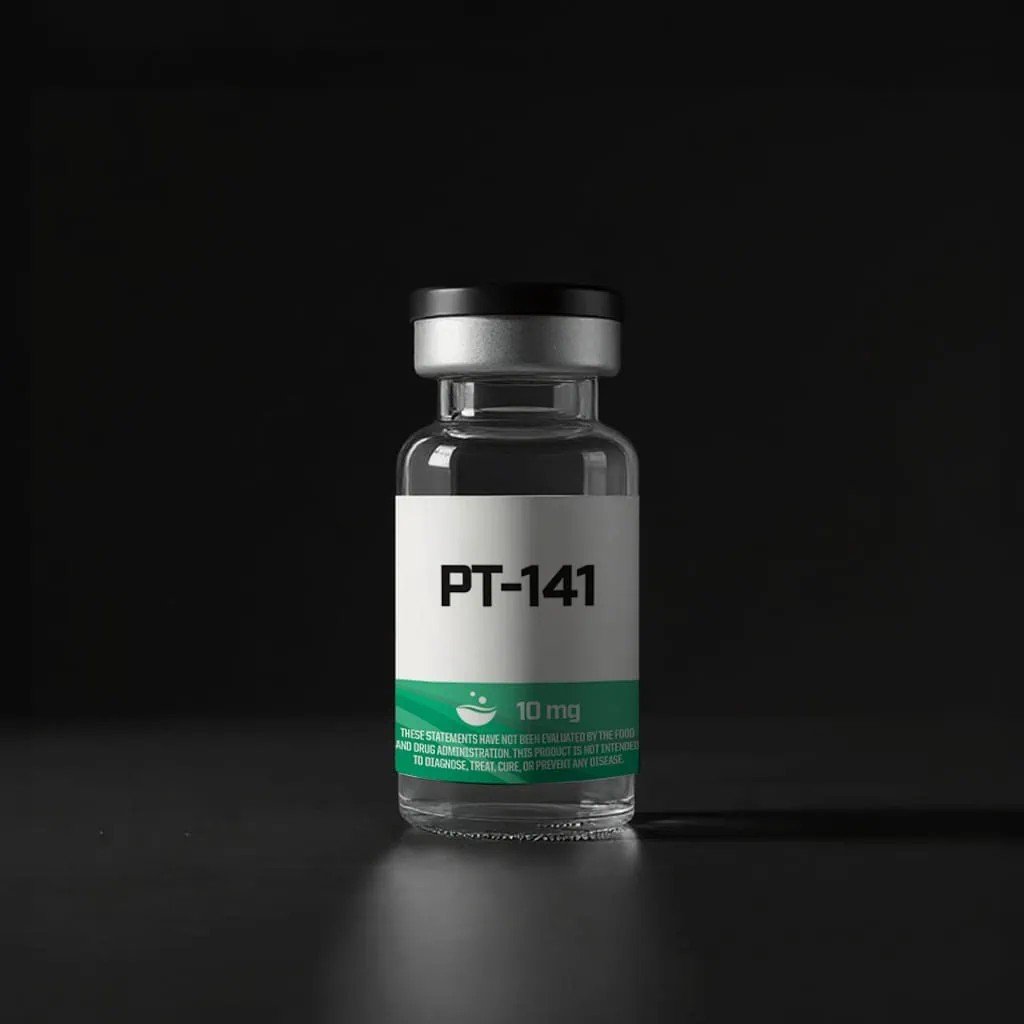
PT-141 Research Peptide
What Is PT-141?
PT-141 Research Peptide is bremelanotide, a synthetic cyclic heptapeptide and nonselective melanocortin-receptor agonist. Its structure is Ac-Nle-cyclo-(Asp-His-D-Phe-Arg-Trp-Lys-OH), containing an N-terminal acetyl group and a lactam ring formed between aspartic acid and lysine. PT-141 was developed from melanocortin peptide research and is related to the endogenous signalling peptide alpha-melanocyte-stimulating hormone. Alternative names include bremelanotide, BMT and the regulated pharmaceutical name thymoxamine is not an alternative identity.
PT-141 can be examined through Soma Chems Lab alongside other compounds in the broader research peptide collection.
Melanocortin-Receptor Signalling
Bremelanotide activates several melanocortin receptor subtypes, with the reported potency order MC1R, MC4R, MC3R, MC5R and MC2R. MC1R and MC4R are considered the most relevant at clinically studied exposure levels. These receptors belong to the G-protein-coupled receptor family and generally signal through Gs proteins, adenylyl cyclase, cyclic AMP and protein kinase A.
MC4R is expressed across multiple central nervous system regions involved in motivated behaviour, autonomic regulation and energy balance. Animal research supports a hypothesis in which MC4R activation within the medial preoptic area modifies dopamine release and neural circuits associated with sexual motivation. Dopamine acts as an excitatory neuromodulator in these circuits, but direct dopamine-receptor binding by PT-141 has not been demonstrated. The precise mechanism responsible for the compound’s human behavioural effects remains unresolved.
MC1R is expressed primarily on melanocytes, where its activation stimulates melanin synthesis through cyclic-AMP-dependent transcription. This pathway is biologically distinct from the central MC4R pathway and explains why one melanocortin agonist can affect several different research endpoints.
Cellular, Animal and Human Evidence
Receptor-binding and functional assays establish that bremelanotide is a melanocortin agonist rather than a phosphodiesterase inhibitor, hormone or direct dopamine agonist. In animal models, PT-141 altered appetitive sexual behaviours following peripheral or central exposure, with the medial preoptic area identified as an important experimental brain region.
Human research includes early placebo-controlled studies in men, phase II dose-ranging studies and two large phase III RECONNECT trials in premenopausal women. The phase III studies reported statistically significant changes in validated desire and distress measures compared with placebo. A regulated bremelanotide formulation subsequently received FDA approval in 2019 for a narrowly defined indication; that regulatory status does not establish the identity or equivalence of unrelated research materials.
Comparison With Related Peptides
PEG-MGF Research Peptide is based on the C-terminal E-domain of the IGF-1Ec splice variant and is investigated in muscle progenitor-cell proliferation and migration models. PEG-MGF lacks PT-141’s defined melanocortin-receptor pharmacology, and its activity depends on the exact peptide sequence and PEG-conjugation chemistry.
Livagen Research Peptide is the Lys-Glu-Asp-Ala tetrapeptide, abbreviated KEDA, studied mainly in liver, immune and digestive-enzyme models. Livagen has no established MC1R or MC4R activity and belongs to a different short peptide-bioregulator research class.
Current Evidence and Limitations
PT-141 has stronger human evidence than many experimental peptides, but findings remain population-, formulation- and endpoint-specific. Its full central mechanism is not established, and regulated bremelanotide data cannot verify the purity, pharmacokinetics or biological equivalence of an independently supplied research peptide.
Frequently Asked Questions
Is PT-141 the same as bremelanotide?
Yes. PT-141 was the research-development designation for bremelanotide.
Is PT-141 a hormone?
No. It is a synthetic cyclic peptide that activates melanocortin receptors.
Does PT-141 work through nitric oxide like PDE5 inhibitors?
Its primary mechanism is central melanocortin-receptor signalling rather than direct phosphodiesterase-5 inhibition.
Additional information
Pt-141
$49.99
Synthetic bremelanotide peptide for melanocortin receptor research.
Reviews
Clear filtersThere are no reviews yet.